
What “verified” means
when we walk the floor.
On most B2B platforms, “verified” means a supplier uploaded a scan of a business licence. On ChinaMakersHub it means our Foshan operations team physically stood on the production line, counted the machines, read the batch records, and signed a dated audit report. This page explains exactly what that audit covers — and what it deliberately does not promise.
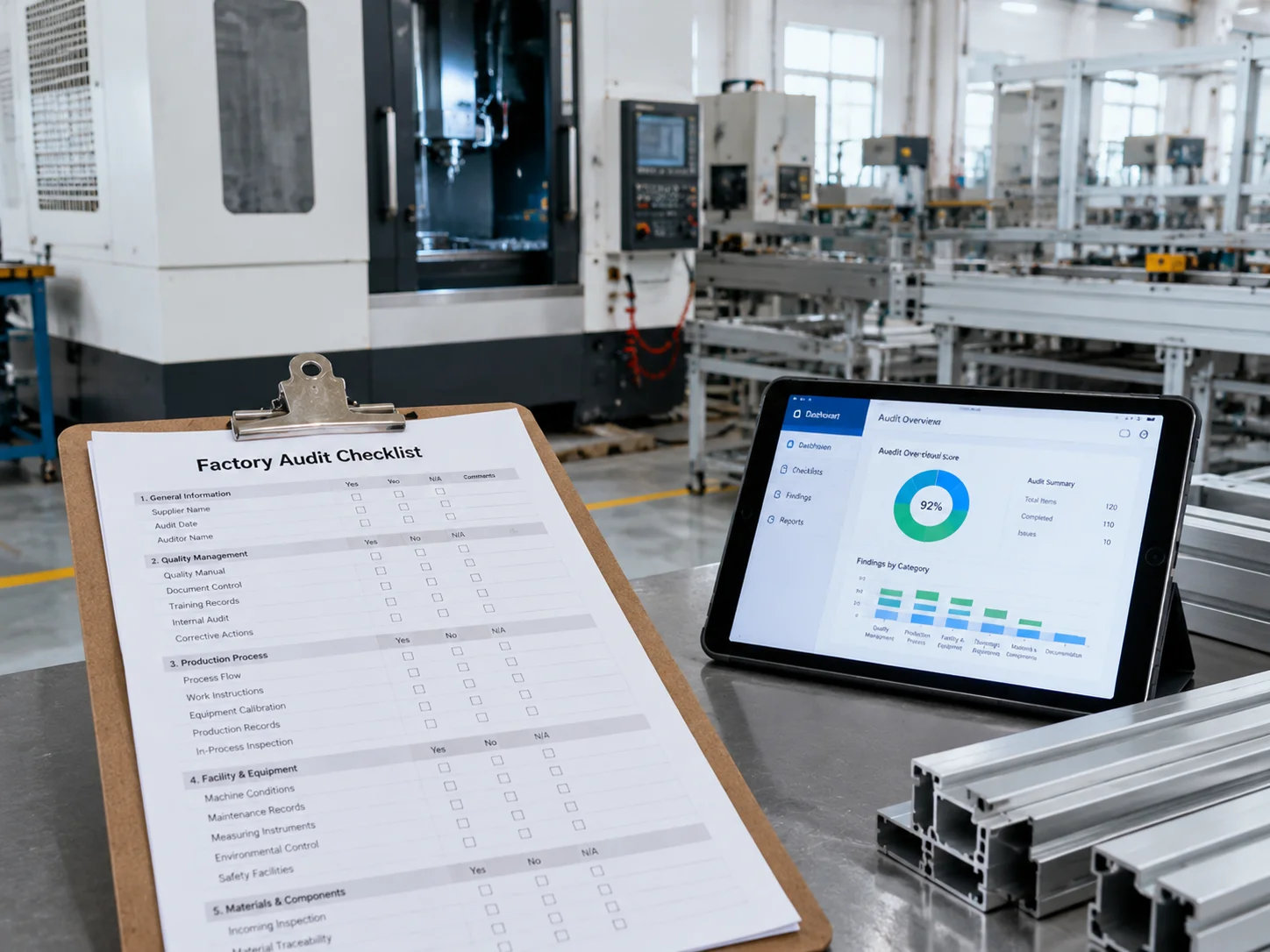
Verification is an operating activity, not a badge.
ChinaMakersHub is the front door of Qingxuan International Trading Ltd., a Hong Kong–incorporated sourcing operator. We do not run a verification department that exists to issue badges; we run an export operation, and verification is simply the discipline we already apply before we put our own buyers’ orders through a factory. Every CMH Verified workshop is one we either already export for or have audited to the same standard we would apply before doing so. Workshops still in checks are listed with a “Checks open” badge and carry no such claim until the audit is done.
That distinction matters because it changes the incentive. A platform whose revenue depends on listing the maximum number of suppliers has a structural reason to make verification cheap and fast — a document upload, an automated database check. An operator who has to ship real containers from these factories has the opposite incentive: a bad audit becomes our problem, our buyer’s delayed order, our reputation. So the audit is thorough because it has to be, not because a marketing page says so.
The audit below is run by people, on site, in Mandarin and Cantonese, by a team that has walked hundreds of Pearl River Delta workshops. It cannot guarantee that nothing will ever go wrong on an order — no honest verification process can — but it does guarantee that the factory on the profile is a real, operating, capable manufacturer of the categories it claims, and that a named human from our team has confirmed it in person.
The audit, in seven stages.
Every factory passes through the same seven stages before its profile is published. The first stage happens at a desk; stages two through six happen inside the workshop, usually across a half to a full day; the seventh closes the loop with a written record and a publication date.
Pre-visit document review
Before a visit is scheduled, we collect and read the factory’s business licence, registered capital, year of establishment, export licence, and the certification claims it intends to make. This desk stage exists to catch the obvious problems early — a licence whose business scope does not cover manufacturing, a trading company posing as a factory, a registration that lapsed — so that an on-site day is only spent on workshops worth visiting.
Production-line walk-through
Our operator walks the actual production line for the categories the factory claims to serve — not the showroom, not the meeting room. For an upholstery factory that means the frame shop, the foam line, the sewing floor and final assembly; for an acrylic display maker it means the laser beds, the polishing benches and the bonding stations. Photographs are taken on site and dated. A factory that cannot show a working line for a category does not get listed in that category.
Capacity & equipment verification
We count the machines, observe the shift pattern, look at the size of the workforce on the floor, and reconcile all of it against the monthly capacity the factory claims. Claimed capacity that the visible plant could not physically produce is the single most common exaggeration in Chinese manufacturing, and it is the number a buyer most needs to be true. The capacity figure on a CMH profile is the figure our operator believed after standing in the building.
Quality system & documentation discipline
We ask to see batch records, QC release certificates, incoming-material inspection logs and traceability documentation — and, just as importantly, we watch how readily the factory can produce them. A factory with genuine quality discipline can pull a batch record for a job from three months ago in minutes. A factory that has to reconstruct paperwork on request is telling you something. We note which it is.
Certification cross-check
A scanned certificate proves only that a scanner exists. For each certification a factory claims — ISO 9001, BSCI, FSC, BIFMA, CE, RoHS and the rest — we verify the certificate number against the issuing or accreditation body, confirm it is current, and confirm the certified scope actually covers the products in question. Certifications that cannot be independently confirmed are not displayed on the profile, regardless of how convincing the paper looks.
Engineering & sample bench review
For buyers running custom-OEM programs, the factory’s engineering depth matters more than its floor space. We review the sample room, talk to the engineering or tooling team, look at recent custom work, and form a judgement on whether the factory can interpret a technical drawing and iterate a sample — or whether it is fundamentally a catalogue producer. That judgement is written into the profile so a buyer knows which kind of partner they are approaching.
Audit record & publication
The operator writes up the audit, the profile is built from what was actually observed, and it is published carrying a dated audit record. The date is not decoration — it tells a buyer how fresh the verification is. The same step schedules the next re-audit. If a factory fails a stage, it is not published; we tell the factory why, and it is welcome to address the gap and request a re-visit.
On-site audit versus document check.
It is worth being precise about why this matters, because “verified supplier” is a phrase every platform uses while meaning very different things by it. The table below contrasts the document-upload model common to large marketplaces with the on-site model CMH runs.
| What is checked | Typical document-upload “verification” | CMH on-site audit |
|---|---|---|
| Existence of the factory | Business licence scan accepted as proof | Operator physically inside the building |
| Factory vs. trading company | Rarely distinguished — both can upload a licence | Confirmed by walking the production line |
| Production capacity | Self-reported number, displayed unverified | Reconciled against observed plant and shifts |
| Category capability | Whatever the supplier types into the profile | Listed only where a working line was seen |
| Certifications | Scanned copy shown as-is | Number cross-checked with issuing body |
| Quality documentation | Not assessed | Batch records and QC logs inspected |
| Freshness of the check | Often a one-time check at sign-up | Dated record, re-audited at least annually |
| Accountability | Automated; no named reviewer | A named Foshan operator signs the report |
Verification has a shelf life.
A factory audited two years ago is not a verified factory today. Workshops move premises, change ownership, shift product mix, let certifications lapse, and gain or lose engineering staff. A verification process that ignores this is selling a snapshot as if it were a live feed.
Every CMH profile is re-audited at least once a year, and the audit date on the profile always reflects the most recent visit. Beyond the annual cadence, a re-audit is triggered early whenever something material changes: a buyer reports a quality issue we trace back to a process gap, the factory tells us it has relocated or retooled, a claimed certification reaches its expiry, or our Foshan team is already visiting the area and folds in a check. If a factory becomes unreachable, declines a scheduled re-audit, or fails one, its profile is withdrawn from the platform rather than left to quietly age.
Buyers can ask to see the underlying audit notes for any factory they are seriously considering. We do not gate our own audit reports behind a paywall or a sign-up. If we verified it, we are willing to show our work.
Verification questions, answered plainly.
Does verification mean the factory is guaranteed problem-free?
No, and we will not claim otherwise. Verification confirms the factory is real, capable, and what it says it is. It reduces risk substantially; it does not eliminate it. That is why we also run sampling and pre-shipment inspection on live orders.
Who actually performs the audit?
Our own Foshan operations team — the same people who run live export programs and whom you will speak to after an inquiry. We do not outsource verification to a third party whose name never appears.
Can I see the audit report for a specific factory?
Yes. Ask in your inquiry and we will share the relevant audit notes for any factory you are seriously evaluating. We do not put our audit work behind a wall.
How often is a factory re-checked?
At least annually, and sooner if something material changes — a relocation, a retool, an expiring certification, or a buyer-reported issue. The audit date on every profile shows the most recent visit.
What happens when a factory fails the audit?
It is not published. We explain the specific gap to the factory; it can address it and request a re-visit. We would rather list fewer factories than list ones we cannot stand behind.
Do factories pay to be “verified”?
Factories pay an annual subscription to be listed on the platform. They do not pay for a verification outcome — a subscription does not buy a pass. A factory that fails the audit is not listed, subscription or not.
See a verified factory for yourself.
Browse the directory — every profile carries its audit date — or send us a brief and ask for the audit notes.