
GONODY Battery Chargers
AA/AAA charging cases from Bao’an, Shenzhen that take both 1.5 V Li-ion and 1.2 V Ni-MH cells — three granted design patents and a customs registration on the record; a very young company whose cells are sourced and whose certificates are the open check.
| Material | |
| Spec / Format | |
| Feature | |
| MOQ | |
| Sample | Within the stated 7–20 day range — confirm cost per part |
| Lead Time | 7–20 days, sampling to production (stated) |
| Payment | T/T — terms confirmed per order |
Charging cases first, cells alongside.
Flip-Top LCD Charging Cases — 4 and 8 Slot
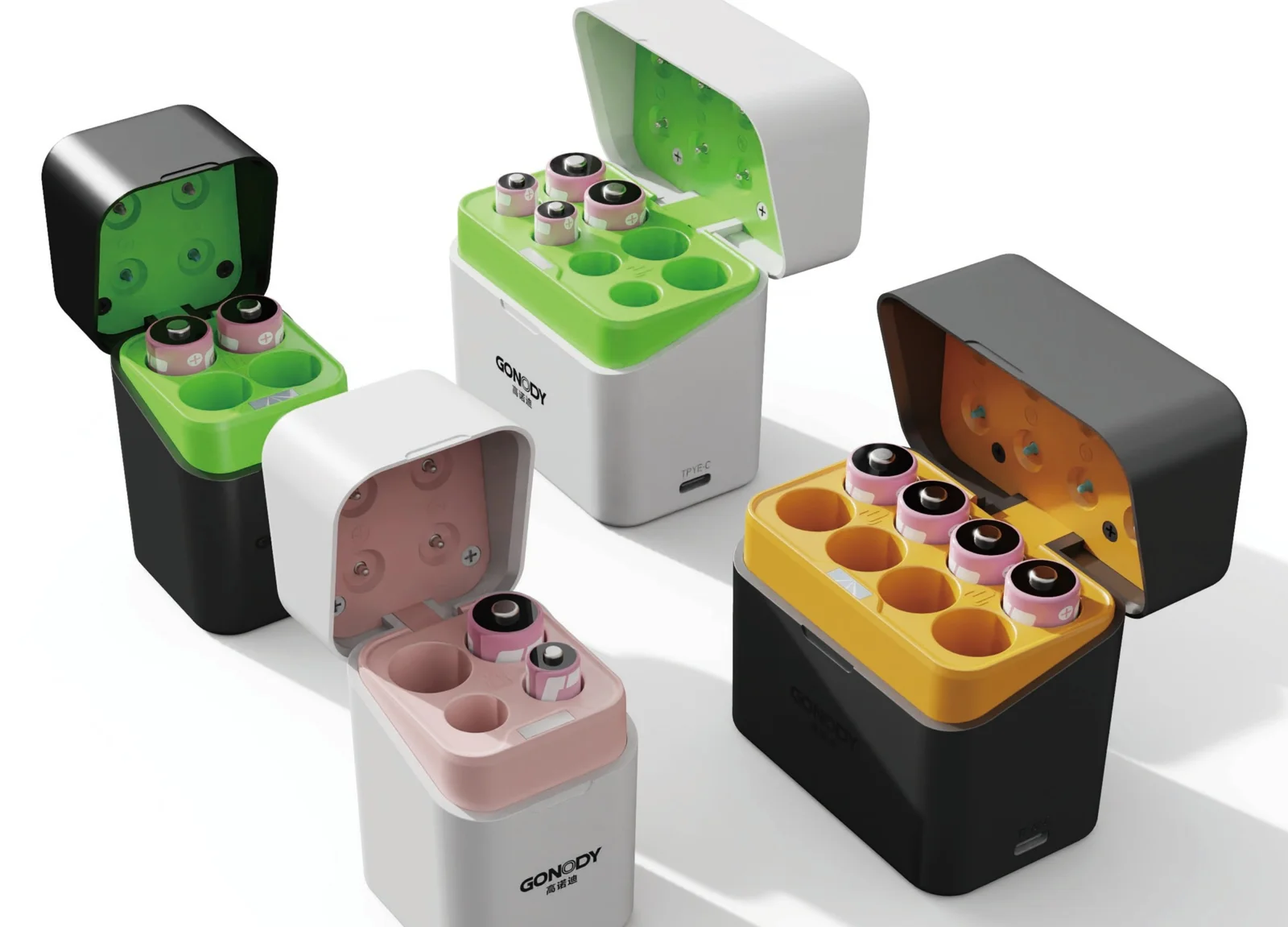
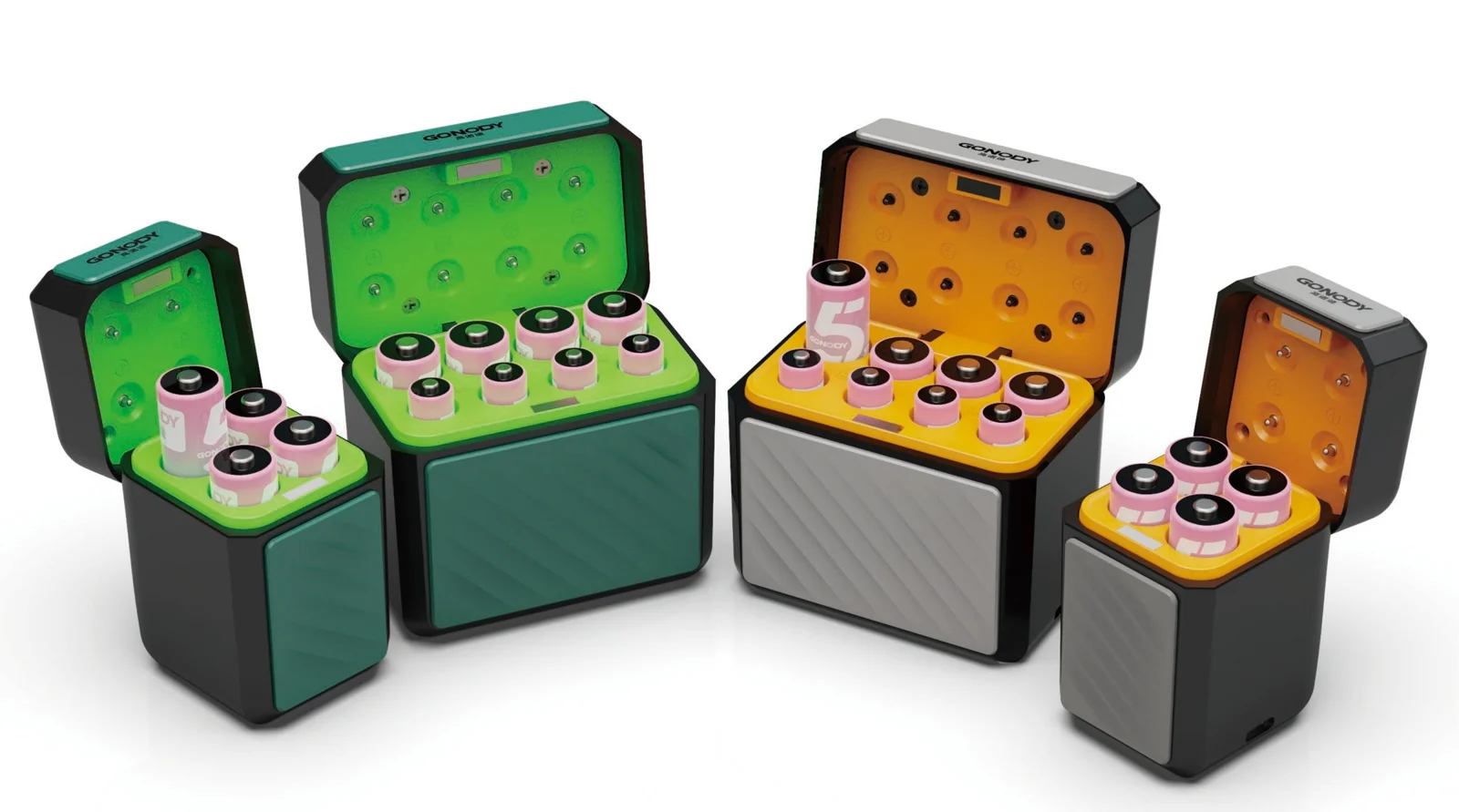
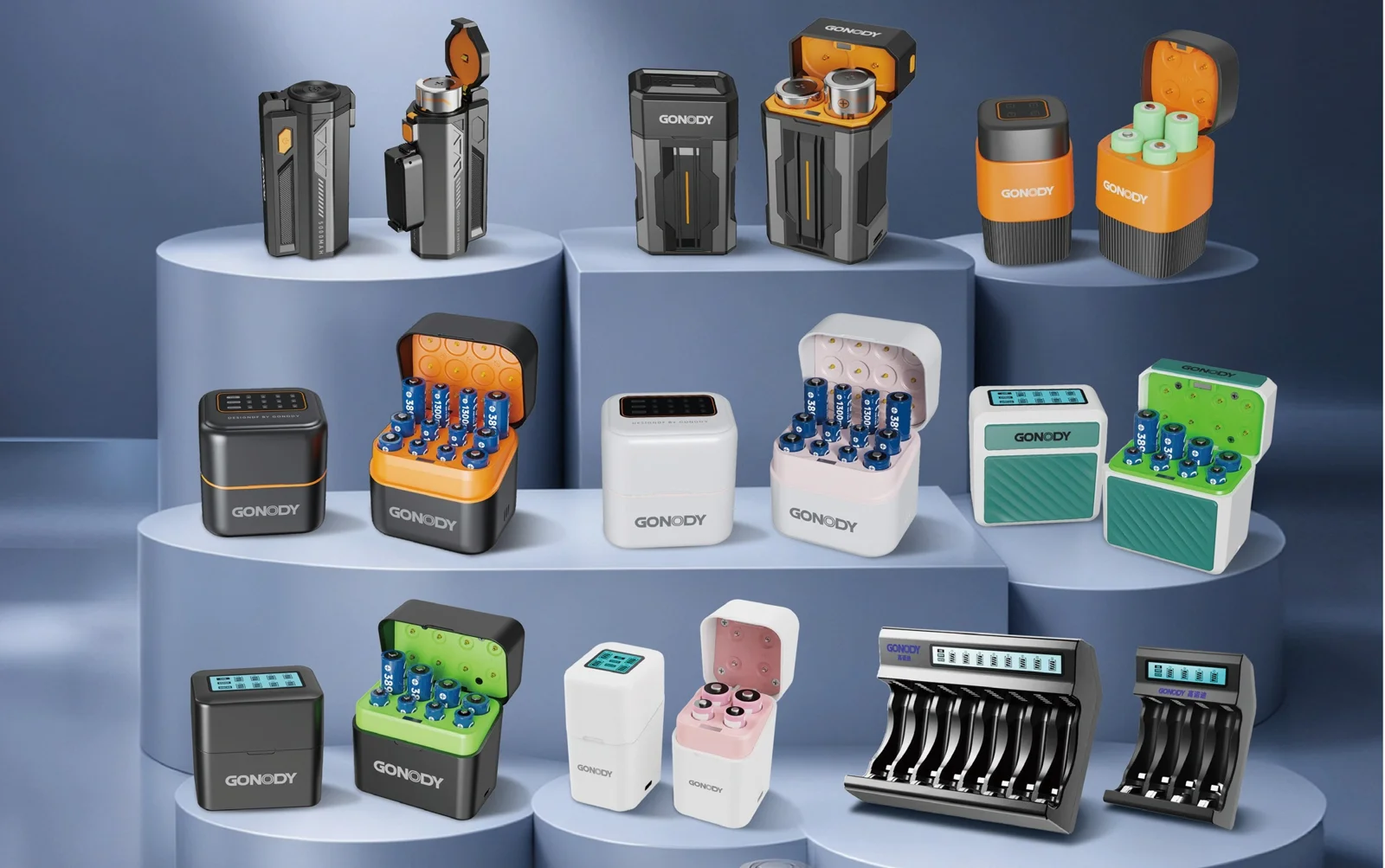
The core line. GD-LCD8100 (8 slots, 74.5 × 74.5 × 45.5 mm, 105 g) and GD-LCD4100 (4 slots, 45.5 × 45.5 × 74.5 mm, 65.5 g), ABS, in 8×AA, 8×AAA or 4×AA + 4×AAA layouts. A hinged lid covers the cells; the display shows per-slot charging state, with an LED version as the lower-cost option. The brochure states each case charges both 1.5 V Li-ion and 1.2 V Ni-MH AA/AAA cells. The September 2026 SKU list splits each case into Li-ion, Ni-MH and dual-chemistry versions, in 5+7 mixed, AA-only or AAA-only layouts, with ready-made two-tone colourways (white/pink, white/green, white/orange, black/green, black/orange) — 227 SKUs across the range.
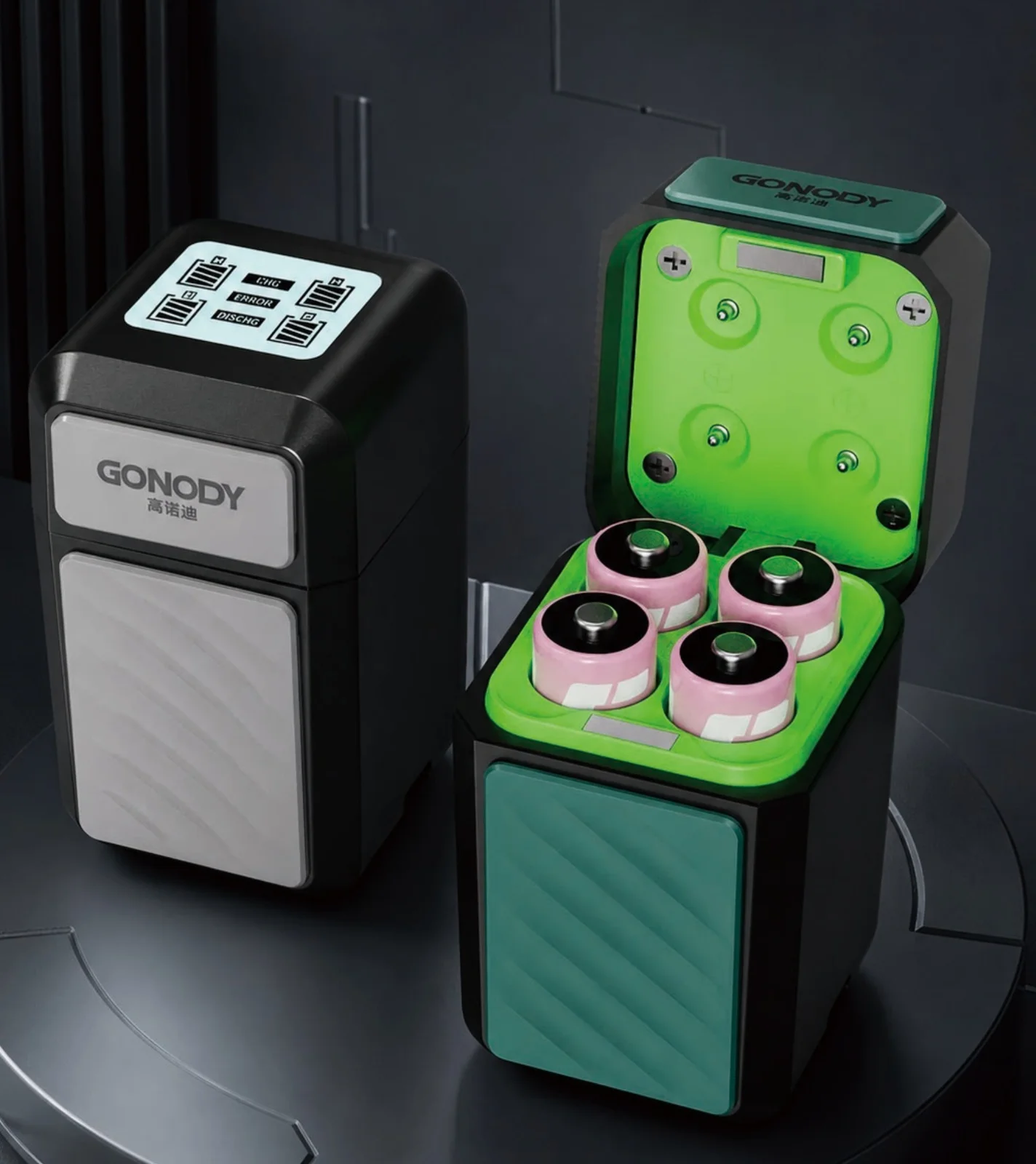
“Fridge-Style” Cases — GD-LCD8500 & GD-LCD4500
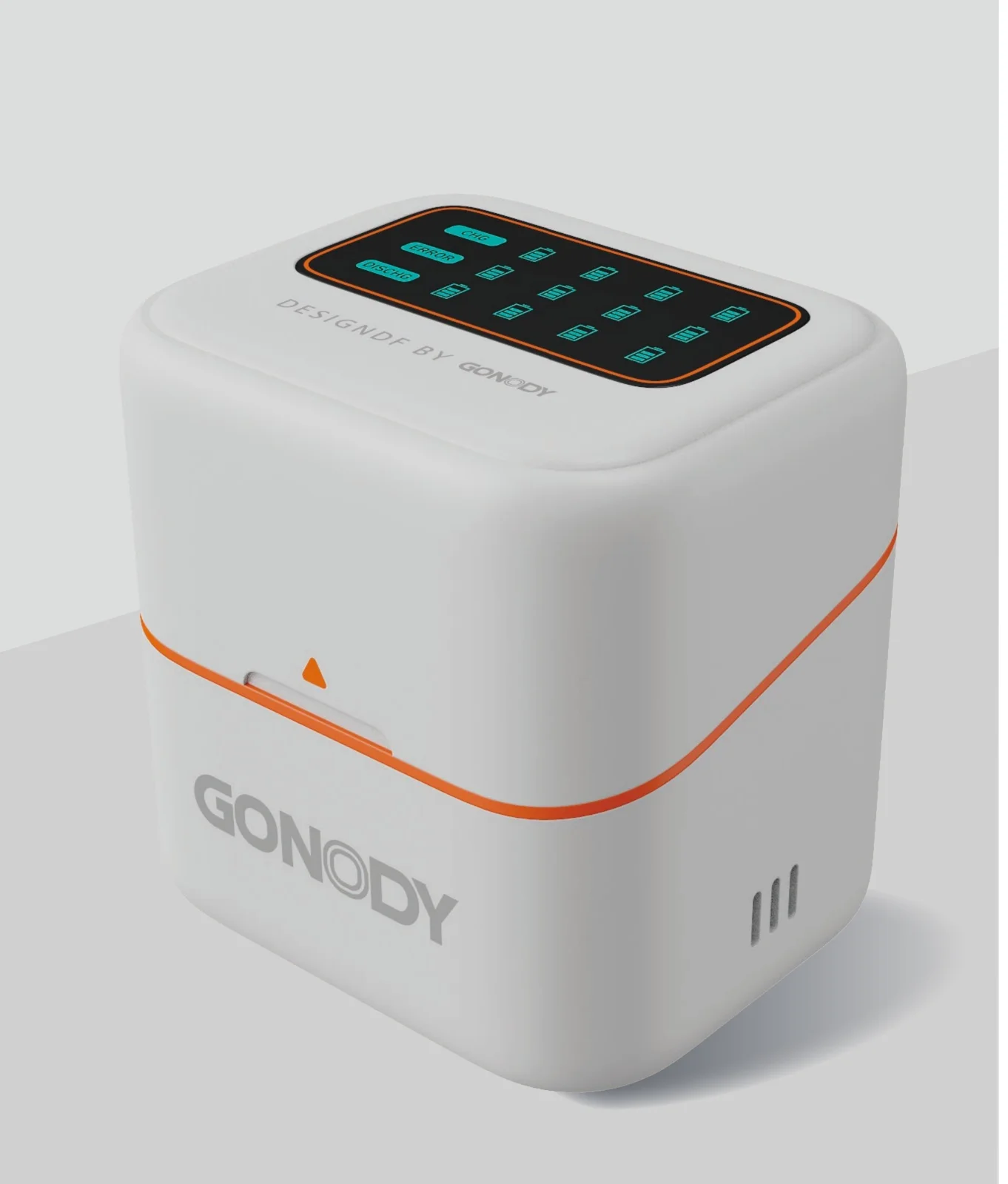
Same electronics in a squarer body with a textured front panel, sold as desk objects as much as chargers: 8-slot GD-LCD8500 (74.5 × 74.5 × 45.5 mm, 105 g) and 4-slot GD-LCD4500 (65.5 g), with a status display on top. Two catalogue colourways — grey/orange and forest green/black — and custom logo on request.
12-Slot Cases and 18650 / 21700 Chargers
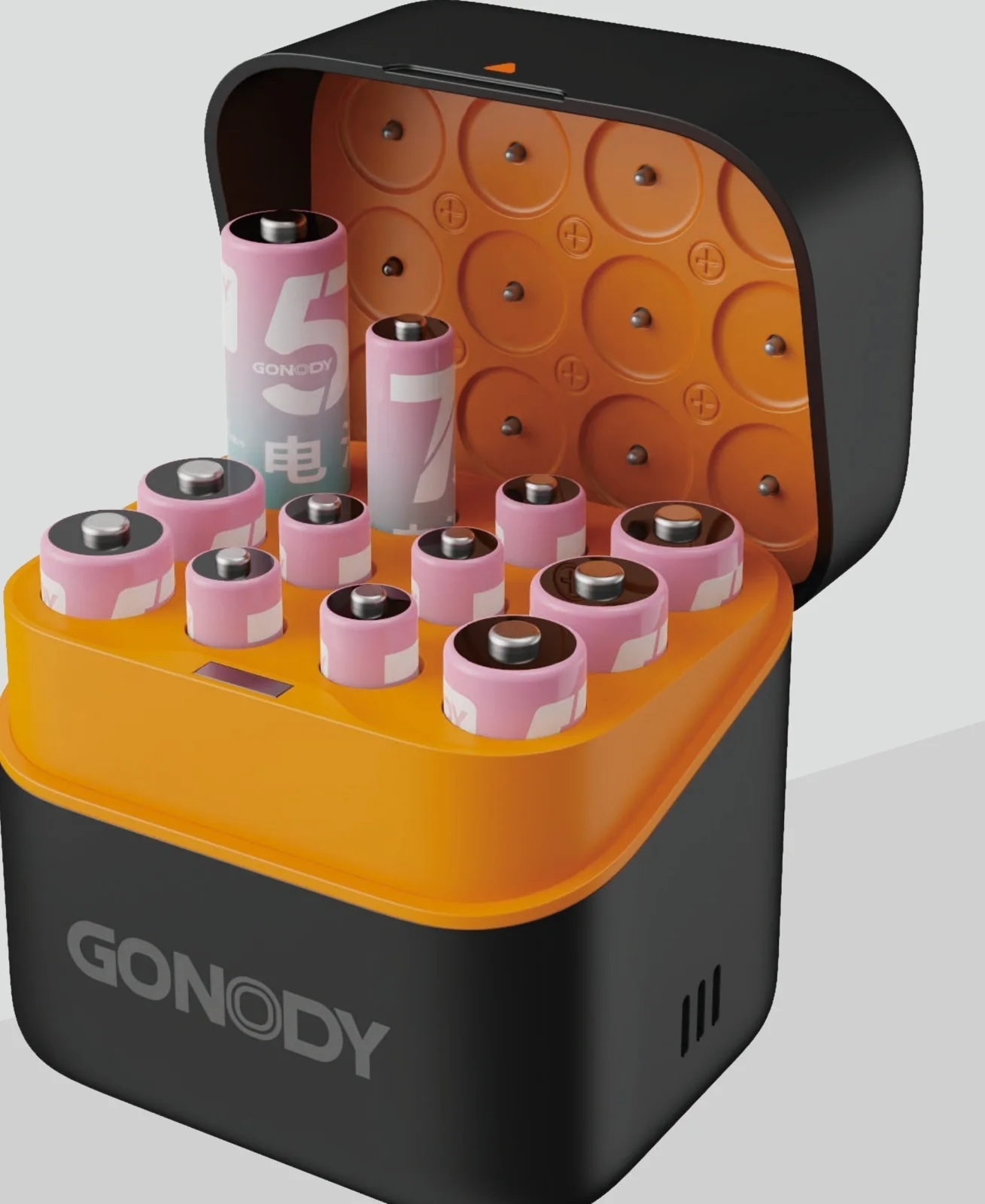
Six AA plus six AAA (or twelve AA) in one flip-top case, LCD or LED status display, USB-C input — the brochure lists charging from a USB port, a car charger or a phone charger; Li-ion, Ni-MH and dual versions in white/pink and black/orange. The company’s September 2026 product list adds flip-top LED chargers for larger cylindrical cells: a 4-slot 18650 case and single- and two-slot 21700 cases. No model numbers or electrical ratings have been supplied for these units; ask for the datasheets.
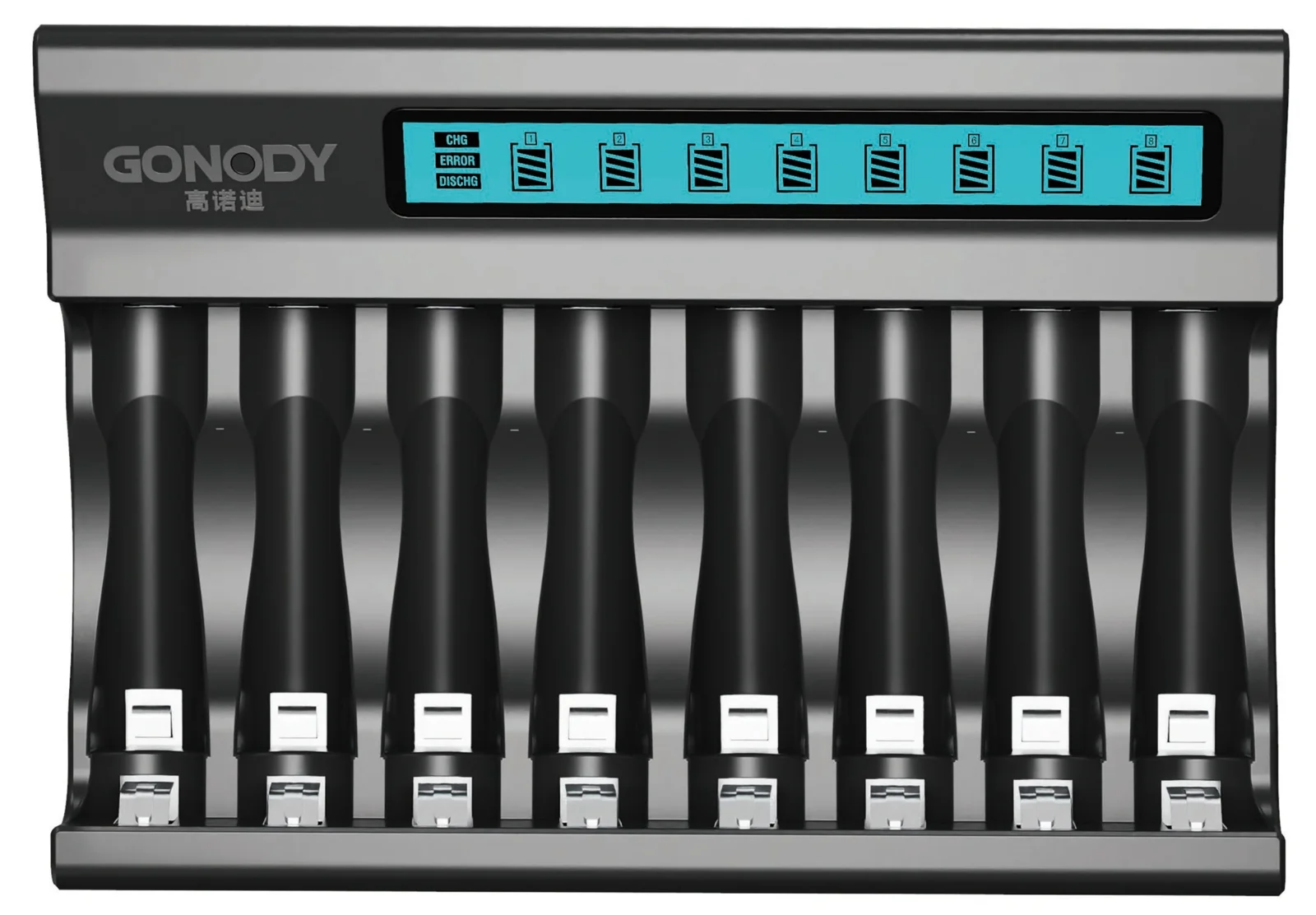
Flat 8-Port Chargers — GD-LCD8200 / GD-LED8600
Open-cradle chargers, 123 × 86 × 31.5 mm, 92 g, ABS. Input USB-C 5 V 3 A; output 350 mA per slot across eight AA/AAA slots. LCD and LED versions, each in Li-ion, Ni-MH and dual-chemistry builds, in green, black and white. The granted design patent CN202530277019.X (8-slot flat charger, granted 2026-02-03) is in the company’s own name and is printed under this product in the brochure.
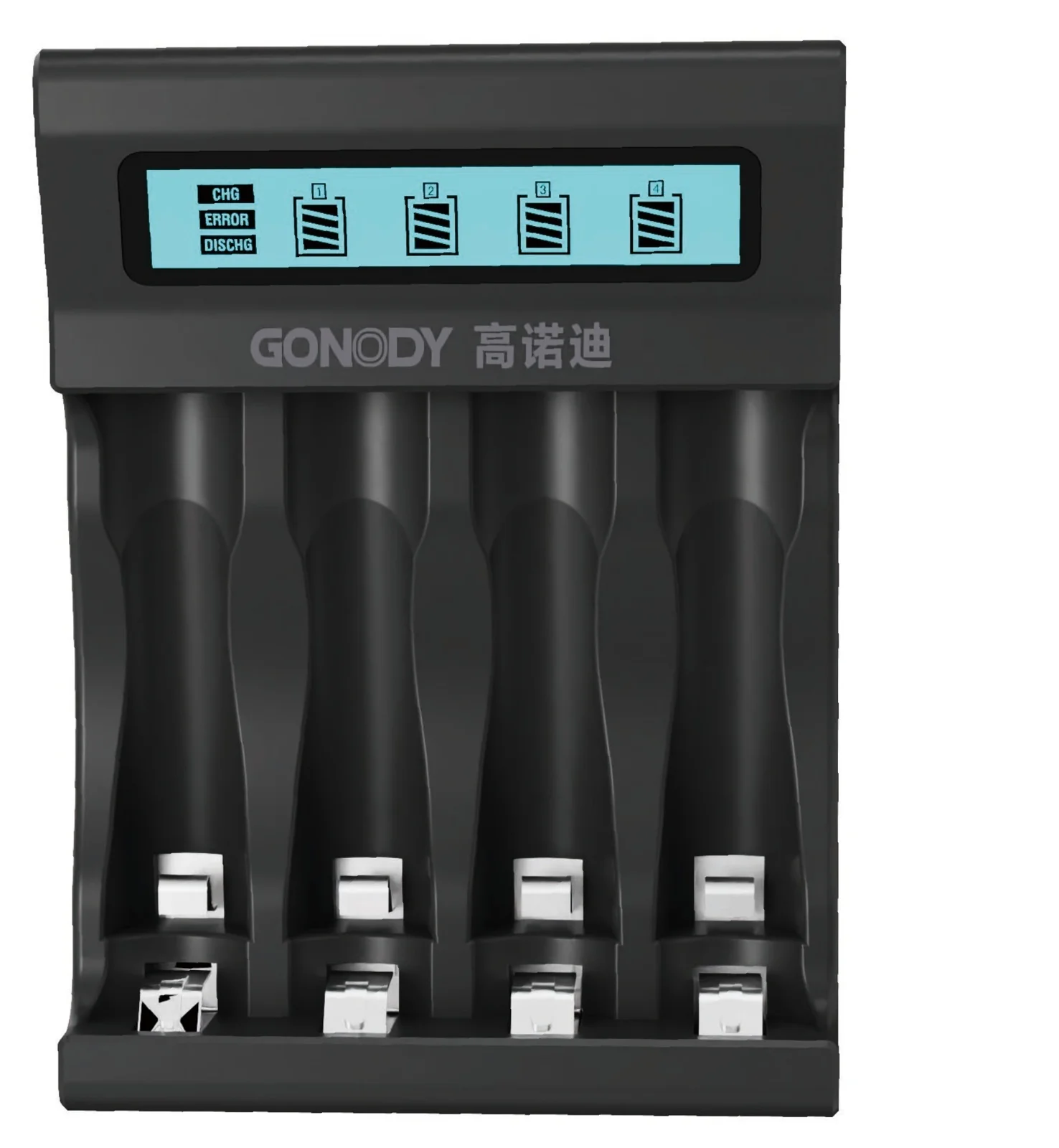
Flat 4-Port Chargers — GD-LCD4200 / GD-LED4600
The four-slot version: 86 × 63 × 32 mm, 55 g, USB-C 5 V 3 A input, 350 mA per slot, any mix of AA and AAA. LCD or LED, three colours. Note: the brochure prints the 8-slot design patent number under this product too — the granted design on record is the 8-slot unit.
Rechargeable Cells — Sourced, Brandable
Sold alongside the chargers under a customer’s brand: 1.5 V constant-voltage Li-ion AA (3,890 mWh, 22.1 g) and AAA (1,300 mWh, 10.76 g), and 1.2 V Ni-MH AA (2,200 mAh) and AAA (900 mAh); stated cycle life 1,800 and 1,000 respectively. The company’s September 2026 product list also names a 9 V square Li-ion cell with a USB-C port, and 18650 and 21700 Li-ion cells. The cells are not made by this company — the test documents pictured in its own brochure name other battery makers (see Capabilities).
What the registry confirms, and what stays open.
The Charging Cases Are Its Own Design
Three design patents are granted in this company’s own name: CN202530277019.X (8-slot flat charger) and CN202530277020.2 (8-slot flip-top case), both filed 2025-05-16 and granted 2026-02-03; and CN202530682979.4 (4+8-slot flip-top), filed 2025-11-19 and granted 2026-05-12. That is the checkable intellectual property. The brochure’s figure of “50+ core patents” is not supported by the record and is not repeated here; design patents protect appearance, not the charging circuit.
The Battery Documents Belong to Other Companies
The brochure photographs four test documents beside its cells: a UN38.3 test report and a CE certificate of conformity for the Li-ion cells, and a material safety data sheet and an IEC CB test certificate for the Ni-MH cells. On all four, the applicant and manufacturer named is another battery company — not this entity and not its affiliates. So the cells are bought in, and those documents do not transfer to an order placed here. Ask for the cell maker’s name and current reports covering the exact cell model you will buy.
Export Route Is on the Record
Beyond an 「货物进出口」 (import/export of goods) clause in the registered scope, the company registered with Chinese customs as an import/export consignor-consignee on 2026-07-13 (Fuzhong Customs, Shenzhen; credit grade: regular enterprise), and has been a VAT general taxpayer since 2026-02-01. It can declare exports in its own name. An Alibaba.com storefront under the same legal name has been open about a year.
A Young Company Spread Across Three Entities
Registered 2025-03-31. Manufacturing clauses — battery manufacturing, battery-parts production, mould making — were added on 2025-12-31; the address moved from Nanshan to the current Bao’an industrial park in April 2026; the legal representative has changed twice. Two further companies carry the same brand name and are linked to the same people: one in Xiamen (registered 2025-11) and one in Qingxi, Dongguan (registered 2026-06, same two shareholders, manufacturing clauses in scope). A buyer should ask which of the three signs, invoices, produces and holds any certificates.
Headcount and Plant Are Not Evidenced Yet
The 2025 annual report shows 0 social-insurance contributors; the brochure states a “20+” R&D team, and the company’s September 2026 intake form states 50–100 employees, a maximum of 20,000 units a month and 240,000 a year. The registered address is unit 206 in factory building B of an industrial park — a form that fits assembly as well as office use. No production line has been sighted, and none of those figures is evidenced yet. Enterprise databases also disagree on the industry code: one records electrical-machinery manufacturing, another “other electronic-product retail”. A video walkthrough of where the cases are moulded and assembled answers most of this.
Certification Marks Disagree Across Its Own Channels
The magazine advert shows FCC-style, CE, ISO, PSE, RoHS and UN38.3 marks. The Alibaba.com storefront lists a different set — ISO 13485, FDA, NIOSH, Type 5/6, OEKO-TEX and CE — several of which are medical-device, respirator and textile schemes with no bearing on a battery charger. No certificate or test report in this company’s name was sighted, and the company’s own September 2026 intake form states it holds no ISO 9001 or ISO 14001 certificate and no third-party test report; it lists a domestic trademark registration and a dangerous-goods packaging certification (not sighted). Treat every mark as a question until a document with this company as holder is on file.
What was checked — and what the check found.
The registry read supports the stamp: the 18-digit credit code passes the national check-digit rule with a 440300 prefix matching the registered Shenzhen address; the company is active; the registered scope carries battery-manufacturing and mould-making clauses (added December 2025) and an import/export clause; a customs consignor-consignee registration dated July 2026 is on record; and no abnormal-operation, administrative-penalty, enforcement, dishonesty or litigation record was visible on the enterprise records read on 2026-09-10 — the four administrative-licence entries are all registration filings. What was read as a document rather than taken on trust: three granted design patents in the company’s own name. What is stated rather than resolved: the business is seventeen months old and trades the brand through three companies; the 2025 annual report shows zero insured staff against a stated 50–100 employees and 20+ R&D team; the brochure claims 50+ patents against three on record; the battery test documents it displays belong to other battery makers; its advert and its storefront show two different, partly irrelevant sets of certification marks, while the company itself states it holds no ISO certificate; and its commercial terms — MOQ 100 pieces, 7–20 days from sampling to production — are stated but not yet tested on an order. What would close it: a plant walkthrough, certificates or test reports naming this company as holder, the name of the cell supplier, and a first order run against the stated terms.
A charger brand, read off the record and its own brochure.
GONODY (高诺迪) is the brand of Shenzhen GONODY Technology Co., Ltd. (深圳市高诺迪科技有限公司), registered on 2025-03-31 and now at an industrial park in Hangcheng, Bao’an, Shenzhen. It designs and sells AA/AAA battery chargers — chiefly flip-top charging cases with a status display — with 18650 and 21700 chargers alongside — and supplies rechargeable AA/AAA, 9 V, 18650 and 21700 cells to go with them, all offered with a customer’s logo and colours. Registration was read in September 2026: active, battery-manufacturing and export clauses in scope, customs registration on file.
The product idea is narrow and clear. Most AA/AAA chargers are sold for one chemistry; GONODY’s brochure states its cases charge 1.5 V Li-ion and 1.2 V Ni-MH cells alike, in 4, 8 and 12-slot formats with ready-made two-tone colourways. The patent record backs the design side — three granted design patents on the chargers and cases, all in this company’s name. The cells are a different matter: the test documents shown in the company’s own brochure name other battery makers, so the cells are sourced and should be qualified at the cell maker.
Read the record as it is: a very young business with a real product, a real patent file and an export registration, and a set of claims that run ahead of the evidence — 50+ patents stated against three on record, 50–100 staff and a 20+ R&D team stated against zero insured contributors, no ISO certificate by its own account, certification marks that change between channels, and three same-brand companies whose roles are not yet explained. The domain gonody.com is not the company’s website; no company website was found. Contact routes through ChinaMakersHub; direct details are exchanged after first inquiry.
Seventeen months, on the record.
Company registered in Shenzhen
Shenzhen GONODY Technology Co., Ltd. (深圳市高诺迪科技有限公司) is registered on 2025-03-31 in Shenzhen. In May the first two design patents are filed — the 8-slot flat charger and the 8-slot flip-top case — and in June the shareholding and legal representative are restructured. Confirmed on the enterprise record.
Brand filings and a manufacturing scope
Trademark filings for 高诺迪 begin in April 2025, followed by GAONODI, GAONODY and GONODY marks; a same-brand company is registered in Xiamen in November, the month the 4+8-slot flip-top design is filed. On 2025-12-31 the registered scope is widened to include battery manufacturing, battery-parts production and mould making.
Patents granted, move to Bao’an
The first two design patents are granted on 2026-02-03 and the third on 2026-05-12. The company becomes a VAT general taxpayer from February, moves its registered address to the Zhuangbian Industrial Park in Bao’an in April, and a third same-brand company is registered in Qingxi, Dongguan in June.
Customs registration
Registered with Chinese customs as an import/export consignor-consignee on 2026-07-13. The legal representative changes again in August. The company trades on 1688, Alibaba.com and a Taobao store; no company website was found, and gonody.com is held by a third party.
Listed on ChinaMakersHub
Registry read 2026-09-10: active, manufacturing and export clauses present, customs registration on file, no adverse record, three granted design patents. Open and stated: zero insured staff, claims ahead of the record, sourced cells with other makers’ test documents, disagreeing certification marks and the three-company structure. On 2026-09-12 the company returns a ChinaMakersHub intake form stating MOQ, lead time, capacity and headcount, and settles on GONODY as its single English name.
Who these chargers are for.
Battery & Accessory Brands
Private-label charging cases with your logo and a ready colourway, plus cells under the same brand. Specify whether you want the cells at all — if you do, qualify the cell maker directly, because the test reports you will need belong to them.
E-commerce & Marketplace Sellers
Flip-top cases are shelf-friendly and photograph well. Plan the shipping route first: loose Li-ion cells travel as UN 3480 dangerous goods with air-freight limits, and many marketplaces ask for a UN38.3 test summary per cell model before listing.
Brands Moving From Ni-MH to 1.5 V Li-ion
A single case that charges both chemistries lets a range carry existing Ni-MH users across. Ask for the per-slot chemistry-detection logic and a test showing what the charger does with a non-rechargeable alkaline cell inserted by mistake.
Toy, Remote & Game-Controller Brands
Bundle packs of AAA or AA cells with a four-slot case. Confirm the charging current suits the cell capacity you choose — the flat chargers are rated 350 mA per slot.
Smart-Home & Sensor Device Makers
AA/AAA-powered locks, sensors and remotes whose users want rechargeables. The 1.5 V constant-voltage Li-ion cell holds voltage flat to cut-off, which suits some devices and upsets low-battery warnings on others — test in the device first.
Gift, Promotional & Retail Distributors
Two-tone colourways and a desk-object form suit gift sets. The stated MOQ is 100 pieces; confirm whether that applies per colourway, and get printing method and retail packaging in writing with units before quoting a promotion.
Sourcing guides for this category
CE, FCC and Product Certification for China-Made Goods
Importing from China: The Compliance Checklist by Market
What Documents to Request From a Chinese Supplier Before Your First Order
Private Label vs White Label vs OEM in China: Which One Are You Buying?
More verified factories
Mingxin Cases
Refined Furniture
Ruida Machinery
Steel-Land Furniture
Frequently Asked Questions
What does GONODY make?
AA/AAA battery chargers: flip-top charging cases in 4, 8 and 12-slot formats with an LCD or LED status display (GD-LCD4100, GD-LCD8100, GD-LCD4500, GD-LCD8500 and a 12-slot mixed case), and open flat chargers in 4 and 8 ports (GD-LCD4200 / GD-LED4600, GD-LCD8200 / GD-LED8600) with USB-C 5 V 3 A input and 350 mA per slot, plus flip-top chargers for 18650 and 21700 cells. Cases come in Li-ion, Ni-MH and dual-chemistry versions — 227 SKUs on its September 2026 list. It also supplies rechargeable AA/AAA, 9 V, 18650 and 21700 cells under a customer’s brand.
Does GONODY make the batteries?
The evidence says no. The company’s own brochure photographs a UN38.3 test report and a CE certificate for its Li-ion cells, and a safety data sheet and IEC CB test certificate for its Ni-MH cells — and on each the applicant and manufacturer is another battery company. The cells are sourced. That is normal for a charger brand, but it means those documents do not cover an order placed with GONODY: ask for the cell maker’s name and for reports covering the exact cell model you will receive.
How many patents does it hold?
Three, all granted design patents in the company’s own name: CN202530277019.X (8-slot flat charger) and CN202530277020.2 (8-slot flip-top case), granted 2026-02-03, and CN202530682979.4 (4+8-slot flip-top case), granted 2026-05-12. The brochure claims “50+ core patents”, which the record does not support. Design patents protect the product’s appearance in China; they are not invention patents and do not extend to other countries.
Which certifications does it hold?
None was sighted in this company’s name, and in its September 2026 intake form the company itself states it holds no ISO 9001 or ISO 14001 certificate and no third-party test report. Its magazine advert shows FCC-style, CE, ISO, PSE, RoHS and UN38.3 marks; its Alibaba.com storefront lists ISO 13485, FDA, NIOSH, Type 5/6, OEKO-TEX and CE — a different set that includes medical-device, respirator and textile schemes unrelated to chargers. Ask for each certificate or test report with the holder name, product model and date, and disregard any mark that cannot be matched to one.
Can it export in its own name?
Yes at the record level. The registered scope includes import/export of goods and technology, and the company registered with Chinese customs as an import/export consignor-consignee on 2026-07-13 (credit grade: regular enterprise). The open question is which company acts: the brand name is also carried by linked companies in Xiamen and Qingxi, Dongguan — confirm the signing, invoicing and exporting entity is the one named on your contract.
Is it a factory, and how big is it?
Unproven either way. The registered scope has carried battery-manufacturing and mould-making clauses since December 2025, and the address is a unit in a factory building in an industrial park. Against that, the 2025 annual report shows zero social-insurance contributors, while the company states 50–100 employees, a 20+ R&D team and up to 20,000 units a month, and one enterprise database classifies the business as electronic-product retail. The Dongguan affiliate, registered June 2026, also carries manufacturing clauses. Ask for a live video walkthrough of moulding, assembly and testing, and which company’s premises you are seeing.
What are the MOQ and lead times?
As stated by the company in its September 2026 intake form: MOQ 100 pieces, 7–20 days from sampling to production (given as one range), no tiered pricing, and a maximum of 20,000 units a month. These are the company’s own figures and have not yet been tested on an order. Send model, slot count, colourway, logo method and quantity through ChinaMakersHub and get the terms confirmed in writing — per colourway, and separately for cells.
What should I check before selling in the EU or US?
For the EU: a USB-powered 5 V charger sits below the Low Voltage Directive range, so the route is EMC, RoHS and the General Product Safety Regulation with an EU responsible person; the cells fall under Batteries Regulation (EU) 2023/1542, whose labelling requirements apply from 18 August 2026 and which requires portable batteries in appliances to be user-removable from 18 February 2027 — AA/AAA formats already are. For the US: FCC Part 15 for the charger’s electronics and federal and California energy-efficiency rules for battery chargers. For shipping: UN38.3 per Li-ion cell model, UN 3480 or UN 3481 classification, and air-freight state-of-charge limits. In every case the report must name the product you buy and the company that made it.
What did the ChinaMakersHub check find?
Run on 2026-09-10 against Chinese enterprise records: the company is active (存续), registered 2025-03-31 in Shenzhen; the credit code passes the national check-digit rule with a prefix matching the address; the scope carries battery-manufacturing and import/export clauses; a customs consignor-consignee registration dated 2026-07-13 is on file; three design patents are granted in its name; no abnormal-operation, administrative-penalty, enforcement, dishonesty or litigation record was visible, and the administrative-licence entries are registration filings only. Stated as found: zero insured staff on the 2025 annual report, two legal-representative changes, a move of registered address in April 2026, two same-brand sister companies, and no company website — gonody.com is a parked domain held by a third party.
Talk to GONODY Battery Chargers directly.
Send the model or slot count, colourway, logo method and quantity, and say whether you need cells. Confirm the stated MOQ (100 pieces) and 7–20 day lead time in writing per colourway, test reports naming this company or the cell maker as holder, a video walkthrough of assembly, and which of the three same-brand companies will sign and invoice. ChinaMakersHub will route the request.